Impact investing allows you to align your financial resources with your charitable goals, combining measurable social or environmental outcomes with financial returns. Unlike traditional grants, which give away 100% of capital, impact investing recycles funds, making them available for future initiatives. In Canada, this approach is gaining popularity, especially among younger generations and high-net-worth families looking to align their investments with their values.
Key Highlights:
- Definition: Investments aimed at generating positive social/environmental impact alongside financial returns.
- Growth in Canada: The market grew from $4.1B CAD in 2013 to $20.3B CAD in 2019.
- Adoption Trends: While only 3% of Canadian donors currently engage in impact investing, 15% plan to adopt it within the year.
- Challenges:
- Aligning portfolios with personal values.
- Overcoming concerns about lower financial returns (data shows 80% aim for market-rate returns).
- Measuring and verifying impact to avoid "impact washing."
- Success Stories: Examples like the Lawson Foundation show how targeted investments in affordable housing and community bonds amplify philanthropic outcomes.
To get started, clarify your values, choose the right investment structures, and work with private bankers in Alberta or other experts to ensure your strategy aligns with your goals. Regular evaluations and clear measurement plans will keep your efforts on track, ensuring both financial and social impact.
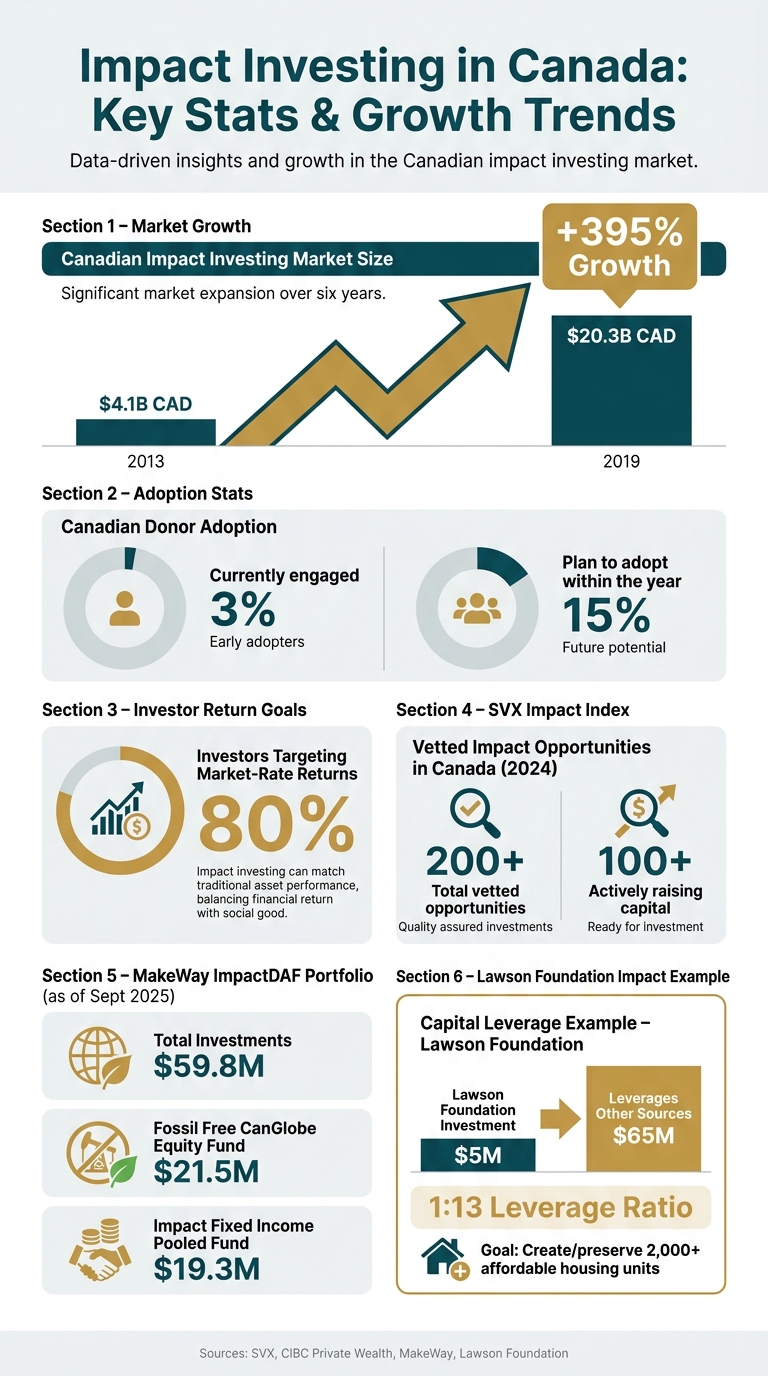
Impact Investing in Canada: Key Stats & Growth Trends
SETSI - IMPACT INVESTING IN CANADA INTERVIEW WITH DR. TESSA HEBB
sbb-itb-e9c03dd
Challenges in Aligning Investments with Philanthropic Goals
Putting impact investing principles into action comes with its fair share of hurdles. Donors often find it difficult to translate their desire to make a difference into concrete investment strategies that align with their philanthropic goals.
Aligning Portfolios with Personal Values
A common challenge is the disconnect between investment decisions and philanthropic missions. Many donors focus solely on financial returns, overlooking whether their investments might actually work against their values. Stacey Faella, Executive Director of the Woodcock Foundation, highlights this issue:
"If you're not paying any attention to what that impact is, there's a good chance your investments are undermining your mission."
To address this, donors should audit their portfolios to identify any conflicts with their goals. Collaborating with an advisor can help realign assets in a way that's both tax-efficient and mission-driven. This step is crucial before tackling concerns about financial performance.
Concerns About Lower Financial Returns
The idea that impact investments yield lower returns is a persistent myth, but the data tells a different story. By 2025, impact investments were outperforming traditional assets, with 80% of investors aiming for market-rate returns.
For those focused on preserving intergenerational wealth, the solution lies in integrating their social impact goals with financial planning. This includes aligning philanthropic ambitions with income needs, cash flow, and estate objectives. Kate Lazier, Director of Philanthropy and Legacy Planning at CIBC Private Wealth, explains:
"Your social impact plan can include environmental, social and governance (ESG) investing, charitable giving, volunteering your time, and how you use your influence."
Once concerns about returns are addressed, the focus can shift to measuring the actual impact of these investments.
Measuring Social and Environmental Impact
Another challenge is ensuring that impact investments deliver on their promises. "Impact washing", where claims of social or environmental benefits are exaggerated or unverifiable, can make donors hesitant to commit their funds.
Thankfully, Canada has tools to tackle this issue. The SVX Impact Index, for example, is a Canadian directory that evaluates investment opportunities based on strict impact, governance, and financial standards. By 2024, it featured over 200 vetted opportunities, with more than 100 actively raising capital. For donors who want to enhance their ability to assess impact, the IMM Fundamentals course offers 8–10 hours of free, self-paced learning tailored to Canada’s social finance landscape.
Setting clear and mutually agreed-upon measurement and reporting standards before investing is one of the best ways to guard against impact washing and ensure accountability.
How Impact Investing Supports Philanthropic Goals
Impact investing offers a way to align financial strategies with philanthropic objectives, addressing challenges while ensuring donors don't have to choose between financial returns and meaningful contributions. Here's how it works.
Aligning Capital with Values and Mission
Impact investing helps align financial resources with personal or organizational values through approaches like ESG integration and thematic investing. ESG integration involves screening investments using environmental, social, and governance criteria. For example, a climate-focused foundation might avoid industries like fossil fuels, while an organization targeting poverty reduction might exclude predatory lenders. Thematic investing, on the other hand, proactively channels funds into areas such as affordable housing, clean energy, or Indigenous economic development.
Take the Lawson Foundation in Canada as an example. In 2022, the foundation committed $500,000 to New Market Funds II, a fund aiming to create or preserve over 2,000 units of affordable housing. For every $5 million invested, the fund expects to leverage $65 million from other sources to align rents with median incomes. This isn't a one-time grant - it’s an investment designed to work in harmony with the foundation's mission, demonstrating how capital can be strategically aligned for maximum impact.
Extending the Reach of Philanthropy
Impact investing doesn't just align with philanthropic goals - it amplifies them by enabling capital recycling. Unlike traditional grants, investments like loans or community bonds allow the principal to return, often with interest, so it can be reinvested in future initiatives. This makes every dollar go further, supporting multiple projects over time.
The Lawson Foundation demonstrated this approach through its $250,000 community bond investment in Innovation Works, a shared workspace for charities and social enterprises in London, Ontario. This followed an earlier $500,000 investment in the same initiative. By recycling capital, the foundation could support additional efforts that might have been out of reach with a traditional grant model:
"Impact investing also allows us to expand in new areas that our members have identified as important but that are not currently priority themes for our granting areas of focus." - Lawson Foundation
Balancing Risk and Impact
Managing risk is a key aspect of impact investing. Diversifying across different asset classes, sectors, and regions helps minimize exposure to any single investment. Donors can start by balancing traditional investments with impact-focused ones, gradually increasing their commitment as they gain confidence. Working with experienced intermediaries also helps, as they bring expertise, due diligence, and established networks to the table.
For instance, the Lawson Foundation invested $1,000,000 in the Community Forward Fund, which provides bridge loans and working capital to Canadian nonprofits and charities that lack access to conventional financing. This approach showcases how thoughtful diversification and partnerships can combine financial caution with a commitment to positive change.
Practical Steps for Canadian Donors to Start Impact Investing
Impact investing offers a way to align your financial goals with meaningful philanthropic efforts. Here’s how Canadian donors can get started with actionable steps.
Clarifying Values and Priorities
The first step is to identify what matters most to you. With over 86,000 registered charities in Canada, narrowing your focus is crucial. Ask yourself: What issues resonate with me? Who do I want to help? Is my focus local, provincial, or national?
Kate Lazier, Director of Philanthropy and Legacy Planning at CIBC Private Wealth, offers this advice:
"Consider how many causes you can realistically support with your time and money. Then consider which causes are most meaningful to you. This may be a cause that has impacted your family or community directly."
To stay organized, create a social impact plan. This plan should include both current actions and estate strategies. A simple guideline is to allocate 80% of your budget to your primary causes, leaving 20% for unexpected needs or opportunities.
Choosing the Right Investment Structures
The structure of your investments can influence both your impact and your tax benefits. For instance:
- Personal donations generally result in tax credits.
- Corporate donations provide tax deductions.
Your choice depends on your financial situation and how you plan to allocate surplus capital.
One smart approach is donating appreciated publicly traded securities directly to a charity or donor-advised fund (DAF). This avoids capital gains tax while still giving you a donation receipt at fair market value. Shea Sanche, Founder of Insight Planning, explains:
"Tax-efficient charitable giving in Canada is driven far more by asset selection, timing, and structure than by donation size."
For donors wanting their funds to have an immediate impact, MakeWay offers ImpactDAF, Canada’s first fully-customizable donor-advised fund that is 100% impact-invested. As of 30 September 2025, MakeWay’s portfolio included $59.8 million in investments, with $21.5 million in the Fossil Free CanGlobe Equity Fund and $19.3 million in the Impact Fixed Income Pooled Fund.
Collaborating with experts can help you integrate these structures into your overall wealth plan.
Working with the Right Experts
Impact investing combines wealth management, tax planning, and philanthropy. To make the most of this strategy, work with a private banker or wealth adviser who understands these areas. They can ensure your philanthropic goals align with your financial strategy, income needs, and estate plans.
Additionally, these professionals can help you navigate compliance requirements like the Prudent Investor Standard for foundations or avoid triggering the Alternative Minimum Tax during high-income years. For a list of qualified experts across Canada, visit Find Wealth Experts and Private Bankers in Canada, which provides a province-by-province directory of professionals who can guide your impact investing journey.
Evaluating and Refining an Impact-Informed Strategy
Once your impact investing steps are in motion, it's essential to regularly evaluate and fine-tune your strategy. This ensures your investments stay aligned with your philanthropic goals and avoid drifting off course or misallocating resources.
Setting Measurable Goals
Defining success in specific terms is the first step. This means going beyond vague aspirations like "support affordable housing" or "reduce carbon emissions." Instead, attach clear targets and realistic timelines to each objective. For example, rather than simply counting actions like scholarships awarded, focus on measurable outcomes like graduation rates or post-graduation earnings.
To avoid overwhelming your team, limit your core metrics to 12–18 indicators per programme. A North American family foundation provides a great example of this in action. They adjusted their approach from merely tracking the number of scholarships awarded (140 annually) to measuring completion rates by income quartile and earnings relative to the local median wage. This shift revealed that students from the lowest income quartile achieved completion rates 22 percentage points higher than the national average. Such insights allow for meaningful adjustments, which are only possible when you focus on outcomes rather than outputs.
"Most families over-report outputs (scholarships awarded, trees planted) and under-report outcomes (employment rates, carbon sequestered)." - Editorial Team, Family Office Advisory
Once these measurable goals are in place, monitoring progress becomes crucial to maintaining alignment with your mission.
Monitoring and Reporting Progress
A clear reporting structure can help track progress effectively. Consider a three-tier approach:
| Reporting Layer | Frequency | Purpose | Framework Used |
|---|---|---|---|
| Programme | Quarterly | Track progress on specific targets | IRIS+ Core Metrics |
| Strategic | Annual | Assess portfolio-level alignment and results | IMP (5 Dimensions) |
| Validation | Triennial | Confirm if initial assumptions hold true | Theory of Change / External Audit |
The Impact Management Project's (IMP) five dimensions - What, Who, How Much, Contribution, and Risk - provide a structured way to evaluate whether your investments are truly making a difference. Among these, the "Contribution" dimension is particularly critical, as it examines whether the outcomes would have occurred without your investment. This helps distinguish genuine impact from mere coincidence. Revisiting your chosen impact measurement frameworks periodically ensures your reporting stays tied to your original goals.
Consistent reporting feeds into ongoing evaluations, enabling you to adapt to new challenges and opportunities as they arise.
Adjusting to Changing Needs
Priorities and circumstances evolve, so it’s important to conduct triennial deep-dive evaluations. These reviews help verify whether your initial assumptions still hold true and whether your original Theory of Change remains relevant. Research indicates that 40% of failures in social programme implementation stem from unexamined or incorrect assumptions.
A strong example of adaptive management comes from Blink CV, a single-family office in the Netherlands. Since 2022, they’ve employed a five-part monitoring and learning framework to shift from linear to systemic investing. Using a visual scorecard with a colour-coded system, they’ve identified alignment gaps across their portfolio spanning Africa, Latin America, and Europe, with a focus on regenerative agriculture and tourism. These periodic reviews allow them to adjust risk preferences, refine impact themes, and seize emerging opportunities - all while staying true to their long-term mission.
Conclusion: Aligning Investments with Purpose
Impact investing offers Canadian donors a way to connect financial goals with meaningful contributions to society. Rather than treating it as a one-time decision, it thrives as an evolving strategy.
With over 86,000 registered charities in Canada, it’s important to allocate funds thoughtfully. Focus on core causes while keeping some flexibility for emerging needs. As Kate Lazier, Director of Philanthropy and Legacy Planning at CIBC Private Wealth, explains:
"Usually people portion about 80% of their total funds allocated to social impact to the key causes they've identified. By keeping a portion of their budget flexible, they can still respond to world events and new ideas."
Impact investing works hand in hand with other initiatives aimed at making a difference. Lazier highlights this broader perspective: "Your social impact plan can include environmental, social and governance (ESG) investing, charitable giving, volunteering your time, and how you use your influence." This holistic approach, blending financial resources, time, and advocacy, can lead to more impactful change. It’s a natural way to align your investment strategy with your philanthropic vision, enabling thoughtful and effective action.
FAQs
How do I choose impact investments that match my values?
Start by defining what matters most to you. Are you passionate about addressing social challenges or supporting environmental initiatives? Pinpoint the causes that resonate with your values and identify the communities or regions you’d like to support.
Once you’ve clarified your goals, incorporate them into your overall wealth plan. This ensures your financial strategy aligns with your desire to make a difference. If you’re unsure where to start, a wealth advisor can guide you in creating investments that reflect your values while maintaining financial balance.
Will impact investing hurt my returns?
Impact investing doesn’t have to come at the cost of returns. In fact, nearly 90% of impact investors say their investments meet or even surpass their financial expectations. These types of investments can deliver competitive profits while also driving positive social and environmental outcomes. By combining financial objectives with meaningful change, impact investing proves it’s possible to achieve both profit and purpose.
How can I prove an investment’s impact is real?
To demonstrate that an investment delivers genuine results, rely on impact ratings that measure progress against set objectives and verify outcomes with solid evidence. Conduct follow-up evaluations to determine whether the anticipated results were achieved. This method promotes both transparency and accountability in assessing outcomes.